
Messaging that knows what is actually in stock.
Most flows run on a timer. This runs on your live inventory position, so an urgency message is only sent when the urgency is real — and never for a product you cannot ship.
What it costs you now
-
Urgency claims that are not true.
A low-stock email for an item that sold out an hour ago does more damage than sending nothing, because the customer arrives at a sold-out page having been told to hurry.
-
Delayed triggers.
Standard platform syncs run on a delay. The high-intent window on an abandoned cart is measured in minutes, not hours.
-
Undifferentiated treatment.
A first-time browser and a customer in your top percentile receive identical messaging, which under-serves one and wastes the other.
How it works
-
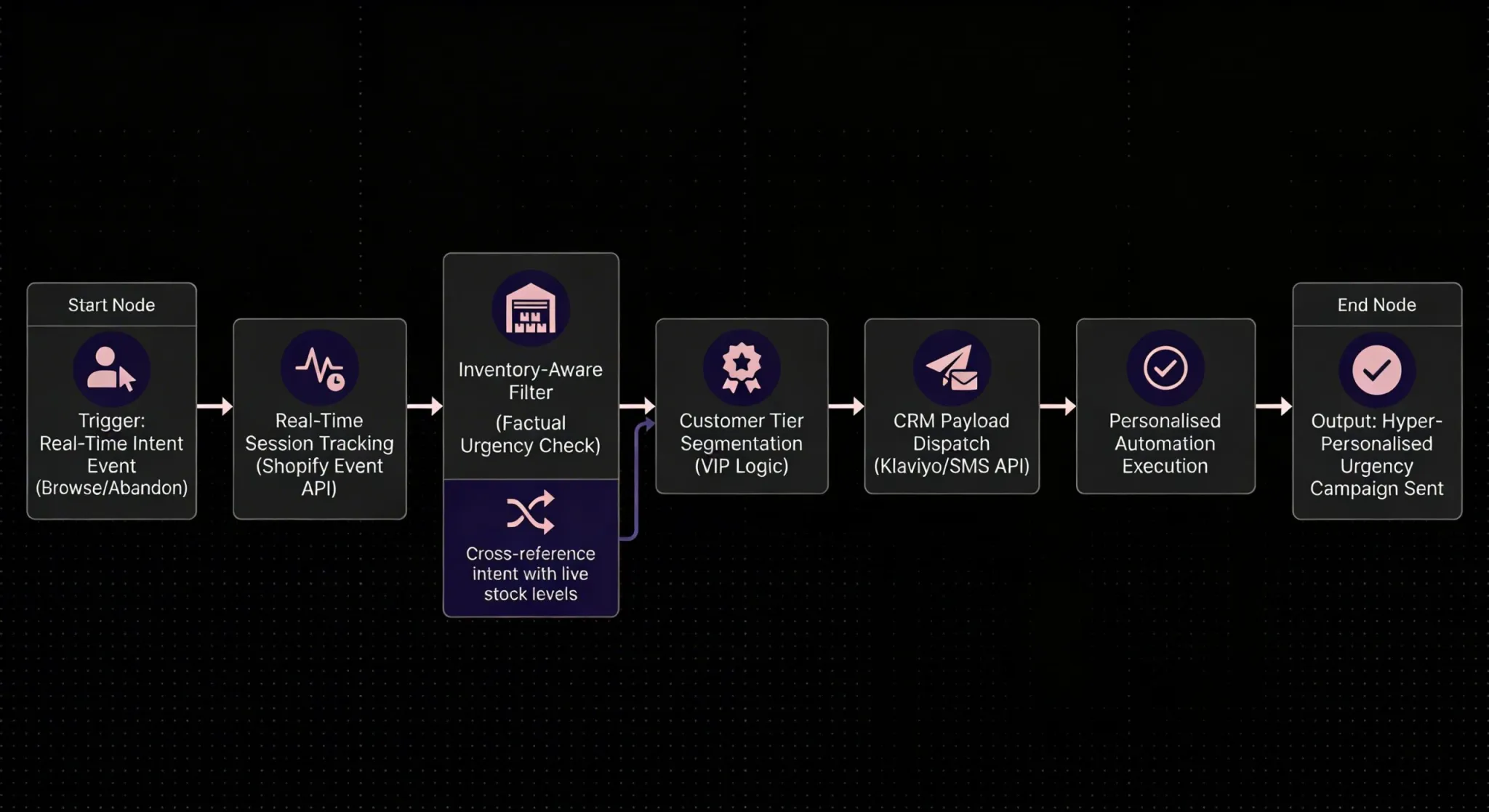
Event monitoring
Cart additions, product views and repeat browsing are read as they happen, rather than waiting for a scheduled platform sync.
-
Inventory cross-reference
Every trigger is checked against live stock. Below your threshold, the message changes from a reminder to a factual availability statement. At zero, it does not send at all.
-
Segmentation
Customer tier and purchase frequency determine the channel — email, SMS, or an internal alert to your team where the order value warrants a person.
-
Delivery
The trigger is pushed to Klaviyo, Attentive, Postscript or your existing platform with the dynamic content already populated.
What it is worth
This is the one solution of the six that generates revenue rather than preventing leakage, so the model is different.
For a store turning £500,000 monthly with roughly £150,000 in abandoned carts, a two percentage point improvement in recovery rate — from 8% to 10% — is £3,000 in additional monthly revenue, or around £1,650 in contribution at a 55% margin.
This figure is modelled from category benchmarks rather than measured on a live implementation, and should be read as an expectation rather than a result.
Commercials
- Implementation from £4,500 · Retainer from £500 monthly, twelve months then rolling
- Live in two to three weeks
- Modelled payback: six to twelve months — modelled rather than measured, see above
Suited to stores with a list above roughly 10,000 subscribers, where there is enough volume for the segmentation to matter.
How the engagement runs
-
 Diagnosis
We map your current flows and identify where inventory position and messaging have diverged.
-
 Scope
Scope
We define the stock thresholds at which messaging changes, and the customer tiers that receive different treatment.
-
 Build
Build
We construct the connections between Shopify, your inventory position and your messaging platform.
-
 Handover
We test the inventory-aware flows against your existing ones so the difference is measured rather than assumed.
Questions
How is this different from a standard Klaviyo flow?
Klaviyo flows are triggered by time and behaviour. This adds live inventory as a condition, so the message content changes with stock position and suppresses entirely when the product is unavailable.
Will it slow my site?
No. Monitoring is server-side. Nothing heavy is added to the front end.
Can it handle different customer tiers?
Yes. Messaging, offer and channel can all vary by lifetime value or tag.
Does it work with SMS?
Yes — Attentive, Postscript, and Klaviyo SMS.
Can it handle replenishment timing?
For consumables, yes. The system tracks individual purchase intervals and triggers a reminder as the customer approaches the end of a typical cycle.
How does it handle back-in-stock?
It can prioritise by customer value, so a limited restock reaches your highest-value customers first rather than whoever subscribed earliest.
Can it handle price-drop alerts?
Yes, for customers who have viewed the product previously.
Who is this not for?
Stores below roughly 10,000 subscribers, or those whose products rarely stock out. The inventory awareness is the point; without stockouts there is little for it to do.
Establish the figure for your store
The Operational Health Scorecard returns a modelled leakage figure in about four minutes.
No call required.
Take the Operational Health Scorecard