
Returned stock back on sale in twenty-four hours, not ten days.
A return that takes ten days to process often misses the window in which it would have sold at full price. This automates the routing, inspection prompts and restocking so the item re-enters inventory while it is still worth what you paid for it.
What it costs you now
-
Markdown on stock that missed its window.
This is the material cost, and it is larger than the working capital argument usually made for returns.
-
Coordination across three teams.
Customer service, warehouse and operations resolving the fate of individual returns through fragmented threads.
-
Inventory drift.
Shopify shows stock you have physically received but not yet restocked, so bestsellers appear unavailable while sitting in a bin.
How it works
-
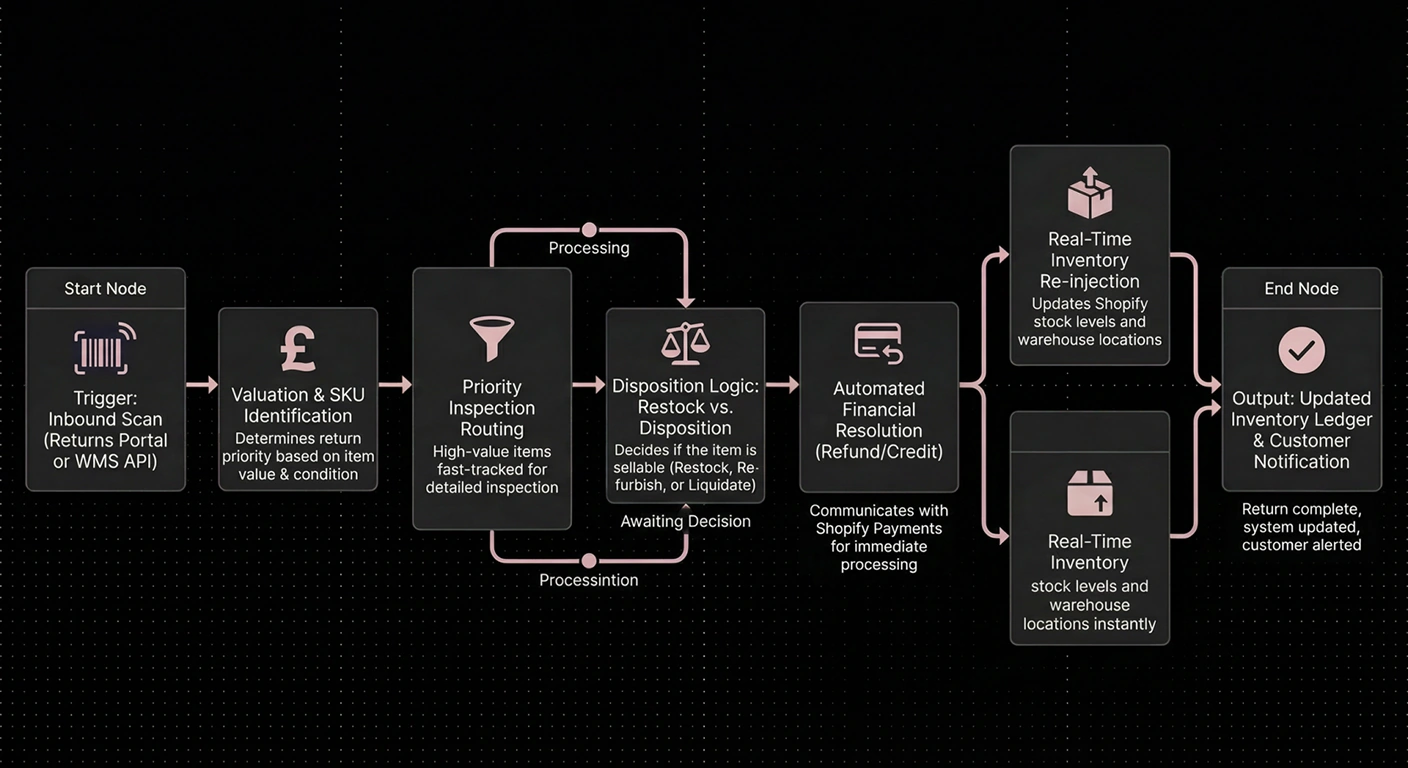
Inbound detection
The system reads your returns portal or warehouse scan events on receipt, identifying the SKU and the original order value immediately.
-
Priority routing
Returns are separated by value. Items above your threshold are fast-tracked for inspection; lower-value items follow a bulk path.
-
Disposition rules
Your rules are applied automatically. An item scanned as resaleable triggers a restock in Shopify. A damaged scan routes to outlet or write-off according to your policy.
-
Financial resolution
Once disposition is confirmed, refund or store credit is resolved without manual entry.
What it is worth
We are deliberately precise here, because the usual argument for returns automation is overstated.
Working capital released is small. Stock that is not sitting in a bin is stock that can sell, but at prevailing cost of capital that release is worth a few hundred pounds a year on any realistic set of inputs. It is real, and it is not the reason to buy. The markdown figure above is.
Markdown avoidance is the material benefit: around £600 a month. Assuming 400 returns monthly at £34 contribution, of which 15% currently miss their selling window and are discounted by 30%. For seasonal or fashion inventory that proportion is considerably higher, and the figure rises accordingly.
Labour is the third component. Five to eight hours weekly of coordination across three teams.
Commercials
- Implementation from £4,500 · Retainer from £500 monthly, twelve months then rolling
- Live in three to four weeks
- Typical payback: seven to twelve months against total first-year cost — the longest of the six
Suited to stores processing 200 or more returns monthly. Most valuable alongside another solution rather than as a first engagement, and we would usually recommend starting elsewhere.
How the engagement runs
-
 Diagnosis
We map your current reverse logistics flow and measure actual dwell time from receipt to restock.
-
 Scope
Scope
We define disposition rules by product value, condition and customer history.
-
 Build
Build
We construct the connections between your returns portal, warehouse system and Shopify.
-
 Handover
We verify the refund and restock triggers against live returns before removing the manual check.
Questions
Does it work with Loop Returns?
Yes — Loop, Rever, and native Shopify returns.
Does it automate refunds?
Yes, according to rules you set. Some merchants refund on scan; others require inspection first. Both are supported.
How does it handle damaged items?
A damaged scan routes to your outlet or write-off path rather than restocking.
Does it update inventory immediately?
Yes, as soon as an item is marked resaleable.
Can it notify customers when a returned item is restocked?
Yes, triggering a back-in-stock flow — most useful for limited or high-value lines.
Can it identify frequent returners?
Yes. High-frequency return profiles can be flagged to your team. What you do with that is a policy question rather than a technical one.
Does it help with reconciliation?
Yes. It produces clean logs of refunds against restocks, which most merchants currently reconstruct manually at month end.
Can rules differ by category?
Yes.
Who is this not for?
Stores below roughly 200 returns monthly, or those selling products with no meaningful selling window — where a ten-day delay costs little, this solves little.
Establish the figure for your store
The Operational Health Scorecard returns a modelled leakage figure in about four minutes.
No call required.
Take the Operational Health Scorecard